
Insights / Project costs and finance
Construction Project Cost Control in Nigeria: A Practical Guide
How contractors can keep an accurate picture of budgets, commitments, actual expenditure and forecast final cost before a project runs into financial difficulty.
Winning a construction contract does not guarantee that it will be profitable. The financial outcome depends partly on how the contractor monitors the cost of work as materials, labour, subcontract activities and project changes accumulate. In Nigeria, material-price fluctuations and payment delays can complicate even a carefully prepared budget.
Recent research into Nigerian construction projects has identified inaccurate cost information, difficulty controlling resources and weak reconciliation between budgets and expenditure as important cost-control problems. A separate study highlighted the impact of material-price volatility and payment delays. The practical response is regular, evidence-based review rather than waiting until final accounts are prepared. Source: 2025 Nigerian cost-control study; source: 2025 financial and operational impacts study.
The four figures every project manager should understand
1. Approved budget
This is the agreed cost baseline for the work, organised into a useful breakdown: preliminaries, substructure, superstructure, finishes, services and other appropriate work packages. Keep track of approved changes separately so the original budget is not silently overwritten.
2. Committed cost
Commitments are authorised obligations that may not yet appear as expenditure: purchase orders, subcontract awards and other approved contracts. They matter because a project can look comfortable in its accounts while substantial obligations remain outstanding.
3. Actual cost
Record expenditure already incurred or properly recognised against the correct project and cost code. Establish a consistent treatment for invoices received, materials delivered but not invoiced, and labour or subcontract liabilities. Avoid counting the same cost twice.
4. Forecast cost at completion
A project manager also needs an estimate of the cost to finish the remaining work. A simple estimate at completion is actual cost to date + credible forecast of remaining cost. Where commitments overlap with actuals or the remaining forecast, reconcile them instead of adding the figures indiscriminately.
A hypothetical project example
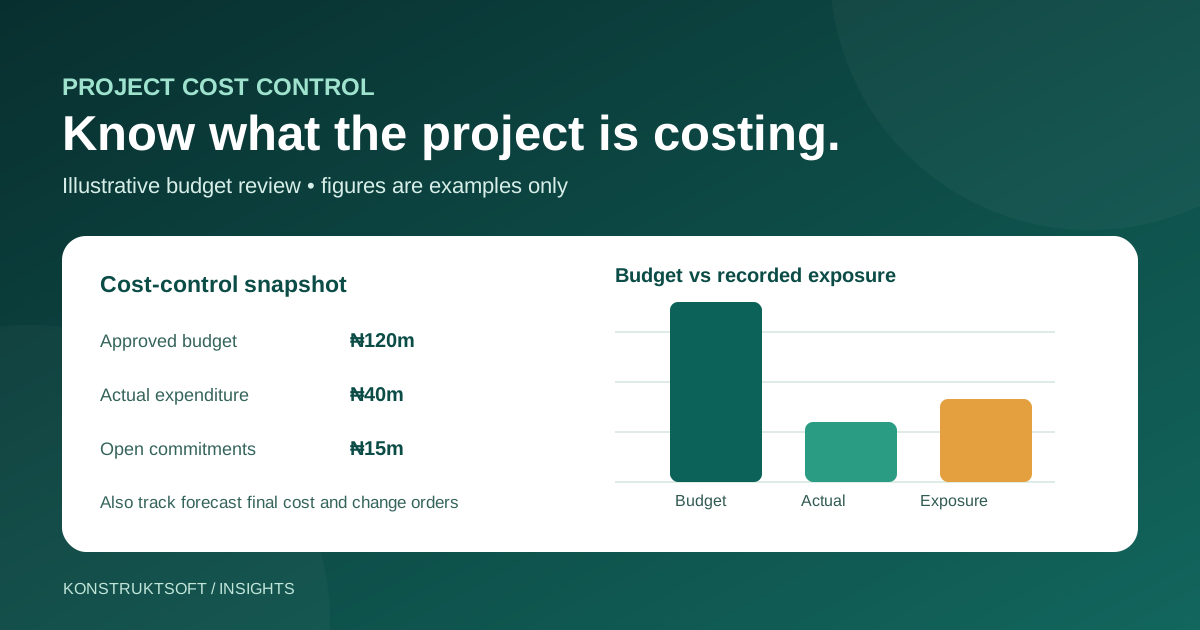
Imagine a contractor with an approved project budget of ₦120 million. Recorded expenditure is ₦40 million and valid outstanding commitments amount to ₦15 million. That makes ₦55 million in recorded expenditure plus open commitments—but it does not mean the balance of the budget is automatically available to spend: substantial work may remain uncommitted.
| Illustrative item | Amount |
|---|---|
| Approved budget | ₦120m |
| Actual expenditure to date | ₦40m |
| Open commitments, excluding amounts already posted | ₦15m |
| Current cost exposure | ₦55m |
| Forecast further cost, including remaining obligations | ₦83m |
| Estimated final cost: actual + remaining | ₦123m |
| Forecast adverse variance against budget | ₦3m |
The project may therefore face an estimated ₦3 million overspend even though actual expenditure is far below the full approved budget. This is precisely why cost control must consider work remaining and price risks, not merely payments already made.
Seven controls to put in place
- Assign cost codes: agree how every requisition, supplier invoice and labour cost will be allocated.
- Use a live commitments register: track orders and contracts from approval to receipt and payment.
- Reconcile costs weekly: compare financial records with approved requests, site progress and delivery records.
- Manage scope variations: record who requested, assessed and approved each change and its cost impact.
- Record price adjustments: update credible forecasts when material and transport rates move.
- Review cash flow: separate project profitability from the timing of payments and receipts.
- Escalate exceptions early: set a clear threshold for management review when a cost code or project forecast moves adversely.
Why site progress must be checked alongside expenditure
Spending ₦40 million is not evidence that one-third of the work is complete. Progress should be assessed from quantities and verified work executed, allowing for the limitations of the contract and reporting method. Regular coordination between the project manager, site manager, quantity surveyor and finance function helps explain why costs and progress differ.
How software supports the process
Software can make cost records, approvals and reporting easier to coordinate, provided data is accurate and responsibilities are clear. KOS MSuite includes construction-related project, procurement and financial management capabilities according to subscription entitlements. Companies should check the precise cost-control reports and workflows available in the package comparison and evaluate them using a realistic demonstration.
Bring more structure to project cost oversight
Explore KOS MSuite’s project-related, procurement and finance capabilities, and review the package that fits your operating requirements.
Related reading
Editorial note: All amounts in the example are hypothetical and do not reflect any customer or project. The calculations illustrate management principles, not a claim about a software-generated report.