
Insights / Procurement and accountability
Construction Procurement Approval Workflows: A Practical Guide
A clear request-to-receipt process helps contractors avoid undocumented purchases, unnecessary delays, duplicate orders and unreliable material records.
A site manager needs reinforcement steel before the next concrete pour. The procurement team wants an approved specification and quantity. Finance needs the project code and spending authority. Meanwhile, the construction programme cannot afford unnecessary delay.
These are ordinary construction-management challenges. Problems arise when a request is made through a message or call but the purchase, delivery and eventual payment cannot be traced through a consistent set of records. The remedy is not more paperwork for its own sake. It is a clear procurement process with responsibilities, practical approval limits and timely information.
Why procurement control matters
Nigerian construction supply-chain research identifies fragmented collaboration, delays and cost overruns as problems associated with traditional procurement approaches. More integrated information sharing and coordination can help, but no workflow or software can guarantee supplier performance or eliminate material-price risk. Source: Ogwueleka (2025), supply-chain integration in Nigerian construction.
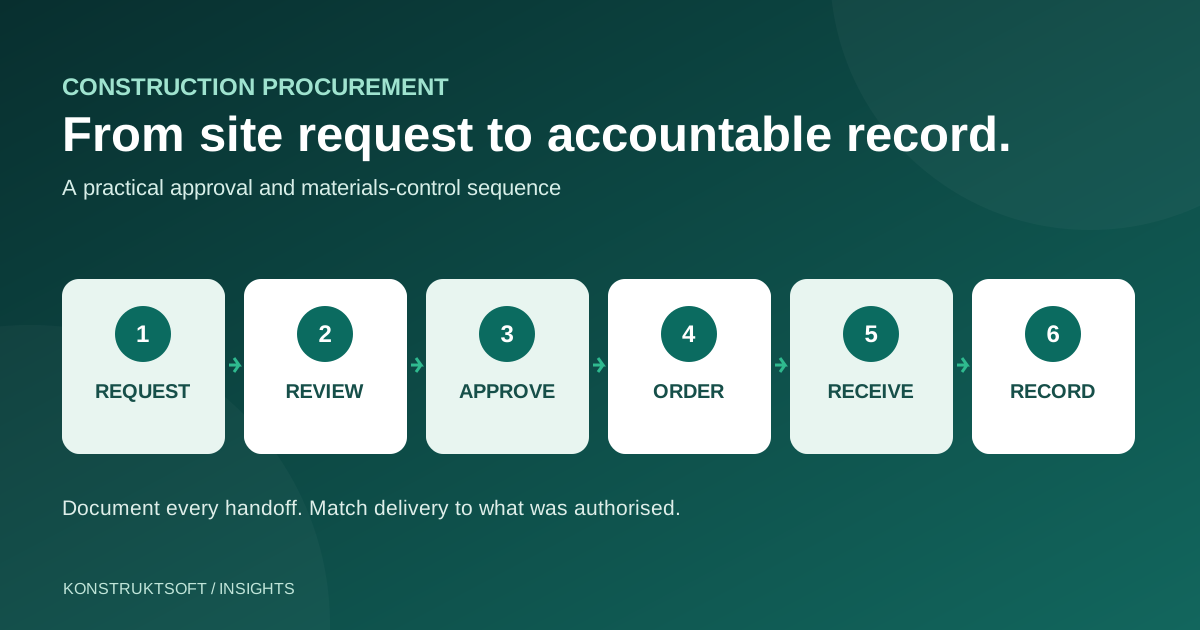
Six stages of an accountable procurement workflow
1. Record the request
The requestor identifies the project, work package, material or service, quantity, required date and reason. Supporting documents might include drawings, specifications, schedules or a site instruction. Use standard descriptions to avoid different teams ordering the same material under inconsistent names.
2. Check the need and available budget
A project or technical reviewer confirms that the proposed quantity and specification match the work plan, and that existing stock or previous orders have been considered. Finance may check the cost code and budget position. The purpose is to prevent avoidable purchases without preventing urgent work.
3. Apply the correct authority
The organisation’s approval matrix should specify who approves a request at each monetary level and who may give technical, financial or executive clearance. A single approval rule may be insufficient for complex companies, but the structure must fit the organisation’s governance.
4. Issue a controlled order
After authorisation, procurement can compare suitable suppliers and issue a purchase order or other documented instruction. Record the agreed price, quantity, delivery terms, supplier and expected date. Material substitutions should follow appropriate technical review.
5. Receive and verify the goods or service
On delivery, the receiving officer checks quantity, condition and specification against the order. Short deliveries, damaged materials or substitutions should be recorded immediately. The receiving record helps establish what was actually supplied rather than what was requested.
6. Match records and recognise the cost
Where applicable, reconcile the approved order, goods-received evidence and supplier invoice before payment. Allocate the cost to the correct project and prevent duplicate recognition. Payment authorisation may be a separate control from purchase approval.
A practical approval-matrix example
The thresholds below are illustrative only, not statutory requirements or recommended universal levels. Each company should establish limits based on its risk, staffing and governance.
| Transaction type | Illustrative control |
|---|---|
| Routine site materials | Technical check followed by financial approval within assigned limits |
| Higher-value purchase | Additional management authority before the order is placed |
| Emergency purchase | Documented exceptional route with prompt retrospective review where policy permits |
| Supplier payment | Separate invoice verification and authorised payment approval |
How to keep approvals from delaying the site
- Publish clear approval owners: employees should know who receives each type of request.
- Specify response expectations: routine and urgent items should not sit indefinitely in an unknown queue.
- Delegate within controlled limits: daily operations need practical authority without eliminating management oversight.
- Provide complete context: approvers should have project, specification, quantity, price and budget details at the point of review.
- Track exceptions: monitor rejected, amended, overdue and emergency requests so the process can improve.
What should the Managing Director be able to review?
At minimum, management should be able to distinguish requested amounts, approved purchases, outstanding orders, goods received, supplier invoices and payments. A purchase approval is not the same as a payment; a delivered quantity is not necessarily the amount invoiced. Maintaining these distinctions supports more dependable decisions.
Using KOS MSuite for procurement-related operations
KOS MSuite is designed to coordinate project activity, procurement requests, defined roles and approvals, finance-related records and management reporting. The exact workflow depth, available forms and user permissions depend on the subscription package and the organisation’s configuration. Review the current package entitlements and request a demonstration using a sample materials transaction from your own business.
Evaluate a clearer procurement process
See how KOS MSuite is positioned to connect requests, responsibilities and authorised business records.
Related reading
Editorial note: This is general operations guidance. All approval limits and example processes are illustrative and must be adapted to the company’s governing policies, contracts and current software capabilities.